
Have you ever wonder where in the world Easter came from? I don’t mean the celebration of the Resurrected Lord on Easter Sunday. I mean the term Easter. It’s certainly not Latin for Resurrected. So how did Easter come to be known as Easter?
The long and the short of it is that no one really knows. We do know that Saint Paul was the first to connect the risen Christ to Passover. He refers to Jesus as the paschal lamb who has been sacrificed for His people’s salvation. It is in reference to the Passover Lamb found in Exodus 12:23. This tie to the past remains with us as we light the Paschal candles and celebrate the Paschal mysteries. But still the question remains, what about Easter?
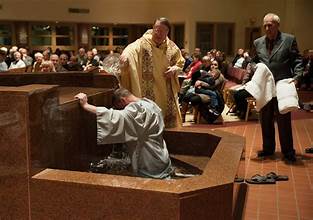
There are at least two schools of thought I’d like to explore. The first can be traced back to the early German Christians. Part of what happens in the Church at Easter Time, most notably on Saturday, is that adults who have completed their religious education are baptized into the Church. While most Catholics are Cradle Catholics, having been brought into the faith as babies, not all are. Easter provides an opportunity for new converts to become part of the Body of Christ, the Body of the Faithful. Holy Week was once referred to as “White Week” to describe the white garments worn by new Christians when baptized. In Latin, the phrase is hebdomnad alba. In Old German, the Latin phrase became esostarum, and eventually evolved into Easter. Or so some claim.

Another theory also comes from an old German word for east which was derived from the Latin word for dawn. In the past, the word Easter could have meant to turn toward the east, the rising sun at dawn. Think of sunrise services as the dawn breaks on Easter morning. What a beautiful and uplifting image. You can almost see the face of God.

Yet when you get right down to it, be it Easter Services or The Mass of Resurrection, or whatever name you use, the reason for Easter is clear. We are His children, and He is our Risen Lord. Easter is a celebration of the greatest love story of all time.

The Catholic Church, in her infinite wisdom, did not designate Easter as a single day. Just as the preparation of mind, body and soul are given the 40 Days of Lent; Easter Sunday is not the end of our Easter Celebration. Beginning today, God has given us the Octave of Easter; an eight-day period to contemplate the mysteries of faith and in particular the resurrection. This eight-day dedication to Easter comes from Jewish observations. After all, Christian Faith, and in particular the Catholic Doctrine, is the acceptance of the Messiah promised to the Jews. For us, the prophecies of the Old Testament are fully realized in Jesus Christ, a Jew. Beginning today we are encouraged to reflect on what God is revealing in our hearts and to build from there a more perfect union with Him. Let that union begin today anew. And let it carry us through the entire Easter Season, beginning with the Octave of Easter and ending 50 days later on Pentecost Sunday.
Hubby and I will celebrate this Easter as we do every Easter, by attending the first Mass of the day. In our neck of the woods that would be the 6am Mass. Which means by the time some of you read this, we will be kneeling in prayer. For me there is no better way to start Easter, or any day for that matter, then to begin by turning to the Lord.
Blessed Easter Supper
Classic Iceberg Salad with Buttermilk Dressing
Brown Sugar Whiskey Glazed Ham
Prosciutto Wrapped Asparagus
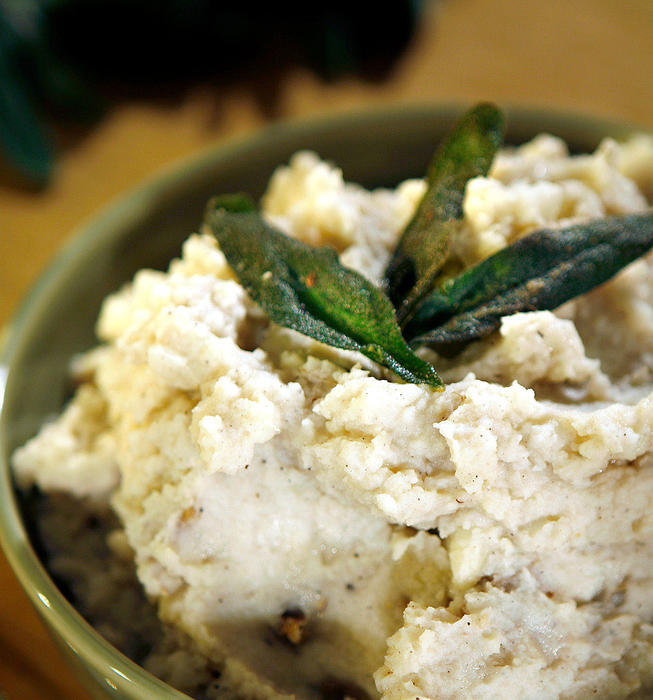
Sage Butter Mashed Potatoes


Classic Iceberg Salad with Buttermilk Dressing
Classic Buttermilk Dressing
2 Garlic Cloves
3/4 cup Mayonnaise
1/2 cup Buttermilk
1 teaspoon Parsley Flakes
1/2 teaspoon dried Minced Onion Flakes
Peel and finely mince garlic in the bowl of a small food processor or mince well by hand.
In a small mixing bowl, mix together the mayonnaise and buttermilk until smooth. Stirn in the minced garlic, parsley flakes and dried onions. Season with a pinch of Kosher Salt and fresh black pepper to taste
Cover and refrigerated for at least 2 hours for the flavors to fully develop.
Iceberg Salad
2 Green Onions
1 small Cucumber
4 White Mushrooms
1 bag Iceberg Mixed Green Salad
1 cup Grape Tomatoes
Butter Croutons as desired
Shredded Cheddar Cheese, as desired
Trim green onions, slice; separating green tops from the onion bulbs, set aside. Peel and slice cucumber. Clean mushrooms, slice and set aside.
Toss the mixed greens with the white parts of the green onions in a large salad bowl. Tuck cucumber slices around the outer edge. Sprinkle salad with mushrooms and tomatoes. Chill until ready to serve.
Serve salad on chilled salad places, sprinkle with tops of the green onion just before serving.
If desired, serve with croutons and shredded cheese. Have dressing in a bowl or boat on the side to use as desired.
Brown Sugar Whiskey Glazed Ham
6 lb Cooked Ham, rump half
1 cup Brown Sugar, packed
1 cup Cola Soft Drink
1 tablespoon Dry Mustard
1 tablespoon Cider Vinegar
1/2 teaspoon Black Pepper
1/4 cup Bourbon Whiskey
Lemon Slices, garnish
Fresh Sage, garnish
Heat oven to 325-degrees.
Place ham on a rack in a shallow roasting pan. Insert an oven-going meat thermometer into center of ham. The thermometer should not touch bone. Bake for 1-1/2 hours.
While the ham bakes, make the glaze. Combine brown sugar, coal, dry mustard and cider vinegar in a medium saucepan. Season with pepper, bring to a boil, stirring to dissolve the brown sugar. Reduce heat; allow glaze to simmer uncovered for about 20 minutes or until reduced to about 3/4-cup. Remove from heat, whisk in the whiskey.
Brush ham with some of the glaze. Continue to bake for another 20 minutes or until thermometer registers 140-degrees.
Slice ham, place on a serving platter. Garnish platter with slices of lemon and a scattering of sage for a “springtime” appearance.
Prosciutto Wrapped Asparagus
1-1/2 lbs Asparagus
4 oz Prosciutto
Olive Oil as needed
Heat oven to 450-degrees. Line a rimmed baking sheet with foil, brush pan lightly with olive oil.
Trim asparagus by snapping off the wooded ends. Wrap each spear with a thin slice of Prosciutto, exposing the tips and the ends. Lay out in a single layer on the prepared baking sheet. Roast in the oven for about 10 minutes, flipping asparagus over half way through for even crispness.
Transfer to a serving platter and enjoy.
Sage Butter Mashed Potatoes
3 lb. small Yukon Gold Potatoes
12 tablespoons (1 1/2 sticks) Butter, divided
12 fresh Sage Leaves
3/4 cup Half-and-Half
Kosher Salt to taste
Freshly Ground Black Pepper to taste
Peel potatoes, cut into quarters. Place in a stock pot with just enough cold water to cover the potatoes. Bring to a boil, then reduce heat to medium and cook until tender, about 15 minutes. Drain well, return to stock pot and “dry” potatoes over low heat for about 5 minutes.
In a small saucepan over medium-high heat, melt 8 tablespoons (1 stick) of the butter. When the foam subsides, add the sage leaves and fry until crisp, about 3 minutes. Using a slotted spoon, transfer the sage leaves to paper towels to drain and season with salt. Reduce the heat to medium and continue cooking the butter until it is brown but not smoking, 2 to 3 minutes more. Pour into a heatproof bowl and set aside.
Meanwhile, in a small saucepan over low heat, combine the remaining 4 tablespoons (1/2 stick) butter and the half-and-half. Heat until the butter melts and the mixture is hot, about 8 minutes.
Mash the potatoes using a potato masher or hand-held mixer until creamy but not yet smooth. Using a spatula, fold in the Half-and-Half mixture and 4 to 5 tablespoons of the brown butter until smooth. Season with salt and pepper.
Transfer the potatoes to a serving dish. Garnish with the sage leaves and drizzle with the remaining brown butter. Serve immediately.
Christ, our paschal lamb, has been sacrificed;
let us then feast with joy in the Lord.
Easter Sunday Readings
1st Reading: Acts 10:34A, 37-43
Responsorial Psalm: Psalms 18:1-2, 16-17. 22-23
2nd Reading: Colossians 3:1-4
Alleluia: 1 Corinthians 5:7B-8A
Gospel: John 20:1-9

 Welcome to Rosemarie's Kitchen
Wonderfully informative post and supprr
LikeLiked by 1 person
Thank you.
LikeLiked by 1 person